

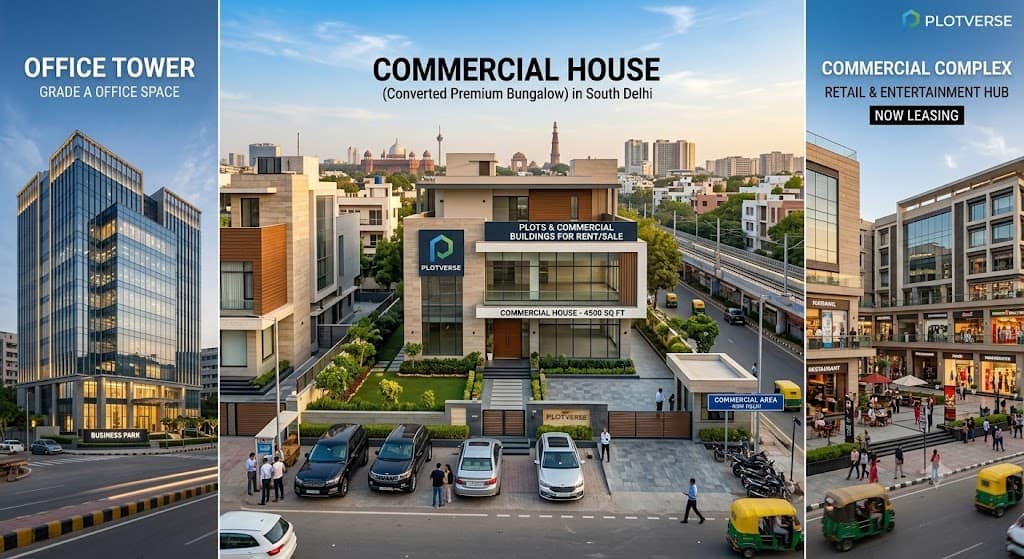
For independent professionals, boutique agencies, medical practitioners, and expanding startups, traditional high-rise corporate offices are not always the most practical or economical workspace solution.
If you are actively searching for commercial houses for rent near me, leasing an independent bungalow, residential villa, or converted standalone floor offers dedicated street-level access, flexible floor plans, and strong local community visibility.
However, converting residential premises for commercial or mixed-use business activities requires a thorough understanding of municipal zoning laws, commercial conversion fees, and neighbor association regulations.
This complete guide provides practical advice on scouting prime localities, navigating Mixed Land Use (MLU) regulations, inspecting utility infrastructure, and executing legally sound commercial leases.
What Is a Commercial House or Commercial Home?
Commercial Definition
A commercial house is an independent residential building, bungalow, or standalone floor leased or legally converted under municipal Mixed Land Use regulations to operate authorized business activities—such as professional consultancies, medical clinics, boutique retail studios, design agencies, or corporate guest houses—while retaining the architectural character of a private property.

Detailed Explanation
In rapidly evolving urban landscapes, many businesses prefer the individuality, privacy, and neighborhood convenience of an independent house over generic office cubicles. A commercial home bridges the gap between residential comfort and commercial utility.
Depending on local municipal master plans (such as the Delhi Master Plan MPD-2021/2041 or municipal corporation guidelines across major cities), independent properties located along designated commercial or mixed-use streets can be legally utilized for specific non-polluting business operations. These properties offer distinct advantages: dedicated front yards, independent driveways, ground-floor customer reception areas, private courtyards for staff recreation, and the freedom to operate without the rigid building management constraints typical of high-rise commercial business parks.
Key Components of an Independent Commercial House
- Ground-Level Street Access: Direct pedestrian and vehicular access from the main road, simplifying client visits, deliveries, and outdoor branding.
- Flexible Multi-Room Layouts: Individual rooms that easily transform into private executive cabins, conference rooms, video studios, soundproof editing suites, or patient examination areas.
- Dedicated On-Premise Parking: Independent driveways, stilt bays, and boundary gates that provide exclusive parking for owners, staff, and visitors.
- Outdoor Green and Breakout Spaces: Lawns, terraces, and open courtyards that provide relaxing open-air meeting spots and event spaces.
- Independent Utility Meters: Dedicated three-phase commercial electricity connections and independent water storage tanks unaffected by other building occupants.
While securing the right commercial property is essential for business growth, proximity to prime living hubs is equally critical for work-life balance. Entrepreneurs, corporate executives, and teams relocating near major business districts often prioritize accessible, high-standard housing nearby. If you are exploring personal living arrangements or employee accommodation close to your new workspace, explore our Residential Flat for Sale or Flat for Rent in India to evaluate top housing corridors, amenities, and budget frameworks.
Why Are Commercial Houses Important for Modern Small Businesses and Professionals?
Direct Answer
Commercial houses provide small businesses and licensed professionals with cost-effective, self-contained workspaces that offer complete operational autonomy, high local neighborhood visibility, flexible operating hours without overtime building maintenance fees, and private client-hosting environments that enhance boutique brand identity.
Detailed Explanation
For customer-facing professionals such as doctors, advocates, chartered accountants, architects, and creative directors, establishing a presence inside a neighborhood residential or mixed-use bungalow builds immediate trust and convenience for local clientele.
Unlike Grade A commercial office parks that impose heavy Common Area Maintenance (CAM) charges, strict 8:00 AM to 8:00 PM central HVAC hours, and expensive visitor parking tariffs, an independent commercial house gives business owners 24/7 operational freedom. Companies can set their own working schedules, install dedicated backup generators, host weekend client workshops, and customize interior architecture without seeking approvals from complex building management committees.
How Does Finding Commercial Houses for Rent Near Me Work?
Direct Answer
Finding an independent commercial house for rent involves identifying properties located on legally designated Mixed Land Use roads, verifying municipal conversion clearances, inspecting electrical load and parking capacities, negotiating commercial lease terms with the property owner, and obtaining necessary municipal trade licenses and registrations.
Detailed Step-by-Step Leasing Process
[1. Business Requirement Plan] ➔ [2. Mixed-Use Zone Scouting] ➔ [3. Municipal & Zoning Verification] ➔ [4. Commercial Lease Negotiation] ➔ [5. Licensing & Interior Fit-Out]
Step 1: Define Spatial Needs and Operational Profile
Analyze your business model to determine space requirements:
- Footfall Density: High-footfall businesses (such as dental clinics, art galleries, or boutique clothing studios) require ground-floor frontage with wide road access.
- Low-Footfall Consultancies: Tech startups, law offices, and financial consultancies can operate effectively on upper floors or quieter interior residential avenues.
- Storage and Equipment Needs: Identify heavy power equipment, server racks, or inventory storage requirements.
Step 2: Scout Localities with Mixed Land Use (MLU) Approvals
When evaluating commercial houses for rent near me, focus on properties situated along designated commercial streets, notified mixed-use avenues, or corner plots facing wide municipal roads (typically 18 to 24 meters wide, depending on city master plan regulations).
Step 3: Conduct Municipal Zoning and Legal Due Diligence
Before placing a booking deposit, verify the property's legal standing:
- Confirm that the property falls under an officially notified commercial or mixed-use road category.
- Verify whether the landlord has paid the mandatory one-time or annual commercial conversion charges to the local municipal authority (e.g., MCD, BBMP, BMC).
- Check the property’s title deeds, property tax receipts, and ensure there are no pending municipal sealing or demolition notices.
Step 4: Negotiate Commercial Terms and Lease Conditions
Draft a comprehensive Commercial Lease Agreement detailing:
- Base monthly rent and payment due dates
- Permitted commercial use category
- Landlord responsibility for municipal commercial conversion taxes
- Right to install outdoor signage and facade branding
- Lock-in duration (typically 2 to 5 years) and rent escalation terms (typically 5% annually or 15% every 3 years)
- Security deposit refund conditions (usually 3 to 6 months' rent)
Step 5: Execute Registered Lease, Secure Trade Licenses, and Move In
Pay the applicable state stamp duty and register the lease at the local Sub-Registrar’s office. Apply for commercial electrical load enhancements, install necessary fire extinguishers, obtain your municipal trade license or Shop Benefits of Renting an Independent Commercial House
Leasing a standalone commercial home delivers unique functional and financial advantages:
- Complete Operational Independence: Operate 24 hours a day, 7 days a week, 365 days a year without overtime air-conditioning surcharges, restricted building access hours, or shared elevator congestion.
- Distinctive Brand Identity and Client Perception: Standalone bungalows project an air of exclusivity, established heritage, and creative personality that sterile commercial towers cannot replicate.
- Lower Overall Occupancy Costs: Zero high-rise CAM loading fees (which often add 25%–35% to commercial tower rents) and lower base rental rates in well-connected suburban neighborhoods.
- Convenient Street-Level Parking: Dedicated private driveway space for executive vehicles, along with easier curbside parking for visiting clients.
- Versatile Multi-Purpose Living-Working Options: Startups and boutique founders can utilize upper levels for executive living quarters or out-of-town guest hosting while conducting business operations on the ground and first floors.
Challenges and Common Mistakes in Renting Commercial Houses
1: Operating in Pure Residential Zones Without Mixed-Use Sanctions
- Cause: Renting a residential house located on a non-notified interior residential road can trigger sudden municipal sealing drives, steep penalties, or permanent closure notices.
- Solution: Confirm that the specific street is explicitly listed on the municipal master plan’s notified Mixed Land Use or commercial corridor list before signing a lease.
2: Neighbor and Resident Welfare Association (RWA) Objections
- Cause: High customer footfalls, noisy delivery vehicles, and street parking congestion frequently lead to friction with surrounding residential neighbors and local RWAs.
- Solution: Choose corner properties or houses directly facing main thoroughfares with on-site parking. Maintain proactive communication with the local RWA and enforce strict parking discipline for employees and visitors.
3: Insufficient Domestic Electrical Load and Water Supplies
- Cause: Standard residential properties are wired for basic domestic lighting (typically 3–5 kW), which immediately overloads when running multiple commercial air conditioners, servers, and office equipment.
- Solution: Make commercial power load enhancement (e.g., upgrading to 15–25 kW three-phase industrial or commercial connections) and installation of back-up generators a formal landlord condition in the lease.
4: Disputes Over Commercial Conversion Taxes and Municipal Levies
- Cause: Ambiguity over whether the landlord or the tenant is responsible for paying annual municipal commercial conversion charges, parking development charges, or enhanced commercial property taxes.
- Solution: Explicitly state in the lease contract that the property owner is responsible for all statutory conversion fees, while the tenant pays only operational utilities and agreed base rent.
Best Practices and Expert Tips for Commercial House Tenants
- Verify Mixed Land Use (MLU) Street Notification: Request the official municipal Gazette or Master Plan notification confirming commercial or mixed-use activity is permitted on that specific street.
- Insist on Commercial Conversion Payment Proof: Check that the landlord has deposited the required commercial conversion and parking development fees with the municipal corporation.
- Inspect Electrical Wiring and Earthing: Have a certified electrician inspect the internal electrical distribution board, three-phase cabling, and earthing infrastructure to prevent server damage or fire hazards.
- Clarify Exterior Signage and Branding Rights: Secure clear written permission in the lease to mount external nameboards, illuminated signage, and directional boards on the front boundary wall or gate.
- Secure On-Site Parking Provisions: Ensure your private compound can accommodate employee two-wheelers and core executive cars to avoid cluttering public neighborhood roads.
- Obtain Fire Safety Clearances: Equip the premises with ISI-marked fire extinguishers, smoke alarms, emergency lighting, and clear exit pathways to meet local fire safety guidelines.
- Document Initial Property Condition: Take extensive photographic and video records of walls, flooring, plumbing fixtures, and existing woodwork before commencing interior modifications.
- Define Modification and Handover Terms: Clearly establish whether partitions, false ceilings, and interior fixtures must be removed or can remain in place when the lease concludes.
- Verify Internet Fiber Ingress Points: Confirm that high-speed fiber-optic commercial broadband providers (such as Airtel, Tata Tele, or Jio Fiber) have active distribution boxes directly outside the property.
- Register the Lease Agreement Legally: Always execute a registered commercial lease at the Sub-Registrar office to protect your tenancy against unexpected property sales or landlord disputes.
Comparison: Commercial House vs Commercial Office Park vs Co-Working Space
| Evaluation Factor | Independent Commercial House | Grade A Commercial Office Park | Shared Co-Working Space |
| Privacy & Autonomy | Complete; dedicated standalone building and compound | High; private office suite with shared building lobbies | Low; shared open floors, meeting rooms, and amenities |
| Operational Flexibility | 24/7 open access with no overtime utility fees | Subject to building HVAC schedules and overtime fees | 24/7 access options, but limited after-hours services |
| Upfront Capital Setup | Moderate (custom interior and furniture fit-out) | High (extensive fit-outs on bare/warm shell spaces) | Zero (immediate plug-and-play setup) |
| Common Maintenance (CAM) | Zero; managed independently by the tenant | High (₹12 – ₹25+ per sq. ft. monthly) | Included in membership fee |
| Outdoor Branding Impact | High; prominent roadside gate and facade signage | Restricted to building directory and suite door | Restricted to desk or small cabin plaque |
| Customer Experience | Exclusive, personalized boutique atmosphere | Impressive, corporate, institutional entrance | Dynamic, collaborative, informal vibe |
| Ideal For | Clinics, law firms, creative agencies, boutique retail | Large corporations, tech HQs, financial institutions | Freelancers, early-stage startups, remote teams |
Frequently Asked Questions (FAQ)
Commonly permitted activities include professional consultancies (doctors, lawyers, architects, chartered accountants), software development offices, creative design agencies, wellness clinics, art galleries, daycare centers, and boutique retail studios that do not cause environmental pollution or noise disturbances.
Key Takeaways
- Verify Mixed-Use Zoning First: Ensure the property is situated on an officially notified Mixed Land Use road to protect your business against municipal sealing actions.
- Confirm Conversion Payments: Obtain written proof that the property owner has settled all municipal commercial conversion and parking development fees.
- Audit Electrical and Power Capacity: Upgrade electrical wiring to three-phase commercial meters and install backup generators to maintain seamless business operations.
- Protect On-Site Parking: Prioritize properties with enclosed driveways and stilt parking to prevent neighborhood parking disputes.
- Execute a Registered Commercial Lease: Formalize your tenancy through a registered lease deed that explicitly defines maintenance boundaries, branding rights, and long-term renewal options.
Final Verdict
Leasing an independent commercial house is an outstanding strategic choice for growing consultancies, healthcare clinics, design studios, and regional startups seeking an inspiring, customizable, and autonomous workspace.
Unlike impersonal corporate towers with expensive shared maintenance surcharges and rigid access rules, a standalone commercial home delivers high brand visibility, neighborhood convenience, and complete operational freedom.
By conducting rigorous municipal zoning due diligence, confirming conversion payments, and maintaining proactive neighborhood relationships, your business can establish an impressive and legally secure operational base.
Conclusion
Securing an independent commercial home provides your business with the autonomy, space flexibility, and local presence required to build lasting client relationships and drive sustainable growth.
By following a structured approach—verifying municipal mixed-use approvals, auditing electrical infrastructure, and negotiating balanced, registered lease terms—you can confidently secure the best commercial houses for rent near me to establish a thriving, future-ready business headquarters.
Begin your search by scouting notified commercial avenues, consulting municipal zoning records, and partnering with experienced local property advisors.